Guide · updated 29 October 2026
Training load when you lift and run in the same week
Every session adds stress — a lift and a run both count. Crave turns each into a training-stress score (TSS), adds them into one daily number, then compares a 42-day average (fitness, CTL) with a 7-day average (fatigue, ATL). Form (TSB) is fitness minus fatigue. Below −10 is fatigued, −10 to +5 is neutral, above +5 is fresh.
Jamie Firth, Hyrox and triathlon. These are estimates from the app’s formulas, not medical advice or a race plan.
One load, not two apps
A heavy lower-body session and a tempo run draw on the same recovery. Splitting them into a gym logger and a run app hides the combined stress. One daily TSS, then fitness versus fatigue, is how you see the week you actually did. Two sessions on one day both add to that number — see whether to run or lift first on a double day. For placing those sessions, see how to plan a hybrid training week. Runners and Hyrox athletes who want the gym week in more detail can start with strength training for runners and Hyrox.
TSS, CTL, ATL and TSB in plain English
The same four numbers appear on Today and in how Crave works. They are TrainingPeaks-style names. The averages are exponential (a 42-day time constant for fitness, 7 days for fatigue), not a simple mean of the last 42 calendar days.
- TSS — stress of one workout. Duration × intensity² × 100, with intensity from RPE, heart-rate zone, a strength estimate, or a duration default by sport.
- CTL (fitness) — 42-day exponential average of daily TSS. It moves slowly.
- ATL (fatigue) — 7-day exponential average of daily TSS. It jumps after a hard day and drops on rest.
- TSB (form) — CTL minus ATL. Below −10 is fatigued, −10 through +5 is neutral, above +5 is fresh. −9.9 is still neutral, not fresh.
Daily TSS is rounded to one decimal before those averages run. Form is also rounded to one decimal.
The awkward bit: scoring a lift
Running has a cleaner signal. A lift is mostly rest between sets, and wrist heart rate often understates the work. Crave still scores it, in this order:
- If the session is a lift (type matching strength, weight, lift or gym) and you logged a session RPE from 1–10, TSS uses that RPE as the intensity.
- Else if average heart rate and your max heart rate both exist, TSS uses heart-rate zones: under 60% of max is intensity 0.5, then 0.7, 0.85, 1.0, and 1.2 at 90%+.
- Else a lift uses a strength estimate: start at intensity 0.35, add up to 0.25 from set count (sets ÷ 40) and up to 0.15 from volume (kg ÷ 20,000), capped at 0.8.
- A run, ride or swim without heart rate uses a duration default (Run 0.8, Ride 0.7, Swim 0.6). Hills can raise that if elevation per kilometre is high.
A completed gym log still gets TSS without a matched Apple Watch workout. Matching a Watch workout can add heart rate to that row. Without sets or volume, a 60-minute Strength session scores 12.25 — the 0.35 default. Logging 16 sets and 8,000 kg on that same hour scores 56.25 (56.3 after the daily one-decimal round). The estimate is honest about being an estimate. It is not a lab measurement and not medical advice.
Worked example: a Hyrox-style hybrid week
These numbers come from the same functions the app uses (calculateWorkoutLoad and computeLoadMetricsHistory), not from invented TSS. Assumptions, so you can repeat them:
- Max heart rate 190 bpm, used only when a session has average heart rate.
- Monday upper: Strength, 60 minutes, 16 sets, 8,000 kg volume, no RPE, no heart rate → TSS 56.3.
- Tuesday easy run: Run, 40 minutes, no heart rate → TSS 42.7.
- Wednesday rest → TSS 0.
- Thursday lower: Strength, 70 minutes, 20 sets, 10,000 kg volume → TSS 65.6.
- Friday Hyrox-style: Functional Strength Training, 50 minutes, average heart rate 148 → TSS 60.2 (heart-rate method, zone 3).
- Saturday rest → TSS 0.
- Sunday long run: Run, 80 minutes, no heart rate → TSS 85.3.
Fitness and fatigue need history. The table is week 26 of that same pattern, so CTL has settled around 44. From a standing start the 42-day average would still be climbing. Form stays in the neutral band all week: it dips after training days and recovers on rest days, but this repeatable week never reaches fresh (above +5) or fatigued (below −10).
| Day | Session | TSS | CTL | ATL | TSB | Form |
|---|---|---|---|---|---|---|
| Sun 25 Oct (before) | Previous long run | 85.3 | 44.0 | 46.0 | −2.0 | Neutral |
| Mon 26 Oct | Upper | 56.3 | 44.3 | 47.5 | −3.2 | Neutral |
| Tue 27 Oct | Easy run | 42.7 | 44.3 | 46.8 | −2.5 | Neutral |
| Wed 28 Oct | Rest | 0 | 43.2 | 40.1 | +3.1 | Neutral |
| Thu 29 Oct | Lower | 65.6 | 43.7 | 43.7 | 0.0 | Neutral |
| Fri 30 Oct | Hyrox-style | 60.2 | 44.1 | 46.1 | −2.0 | Neutral |
| Sat 31 Oct | Rest | 0 | 43.1 | 39.5 | +3.6 | Neutral |
| Sun 1 Nov | Long run | 85.3 | 44.1 | 46.0 | −1.9 | Neutral |
Wednesday and Saturday are the freshest days of this week (+3.1 and +3.6). They are still short of the +5 fresh threshold. Stacking extra intervals on the lower-body day would push fatigue up faster than fitness; the 7-day average is the one that would move first. For a week that already includes functional work next to gym and running, see the Hyrox training plan with lifting. If that functional day is sled push and pull, see where sled work sits in a lifting week. If it is wall balls, see where wall balls sit next to squat days and hard runs. If it is burpee broad jumps, see where burpee broad jumps sit next to heavy pressing. If it is farmers carry, see where farmers carry sits next to deadlift day. If it is sandbag lunges, see where sandbag lunges sit next to a squat day. Racing DEKA instead of Hyrox? See how to add DEKA FIT, MILE or STRONG to a week you already lift and run. Racing Deadly Dozen? See how to plan a Deadly Dozen week around lifting and running. Racing ATHX? See how to fit ATHX Strength, Endurance and MetCon X into a lifting week. Only have 3 or 4 days? See Hyrox training on 3 or 4 days a week when you also lift.
Sleep and HRV next to load
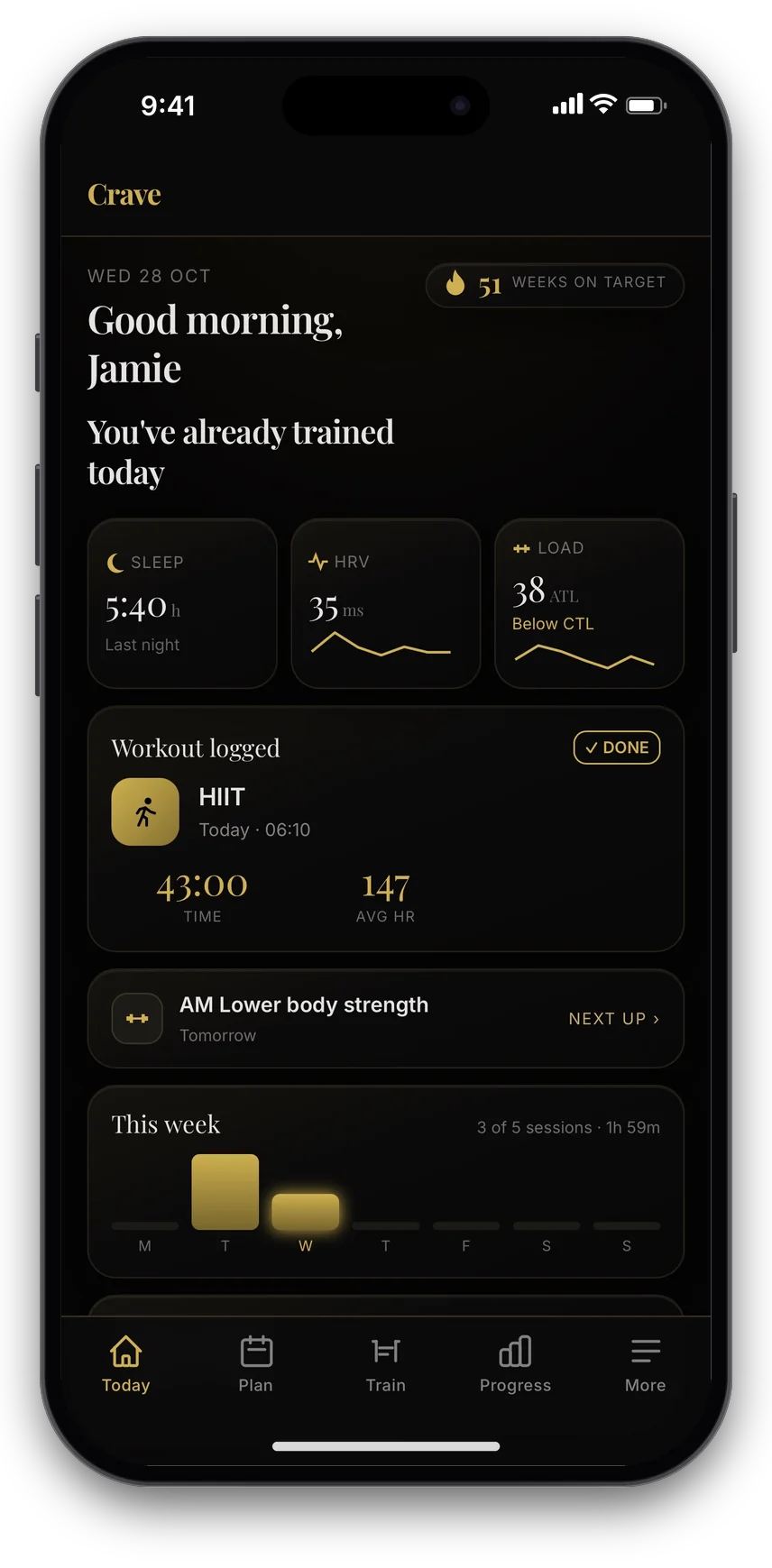
Form is a fact about load. Today’s training call can still say take it easy when sleep or HRV look off, even if TSB is only −3.2 (neutral). The rules, from the same verdict the app shows:
- Take it easy when last night’s sleep is 40 minutes or more below your usual (from the last seven nights of 3+ hours), or under 6 hours if there is not yet a usual; or HRV is at or below 85% of usual; or form is fatigued (TSB below −10).
- Ready to push when sleep is around usual (within 40 minutes and at least 6 hours) and form is fresh (TSB above +5).
- Train as planned when nothing above fires — including this whole example week, if sleep and HRV are fine.
Nights shorter than 3 hours are ignored when building “usual” sleep. Usual HRV is the average of those same recent mornings that have a reading. A higher resting heart rate on its own does not change the call if sleep and HRV look fine. After you have already trained, the label becomes session done rather than a second piece of advice.
There is no separate “rest” verdict from sleep and HRV. Take it easy still leaves the session on the plan. These readings come from Apple Health when you grant them. They are not medical advice.
How Crave holds this
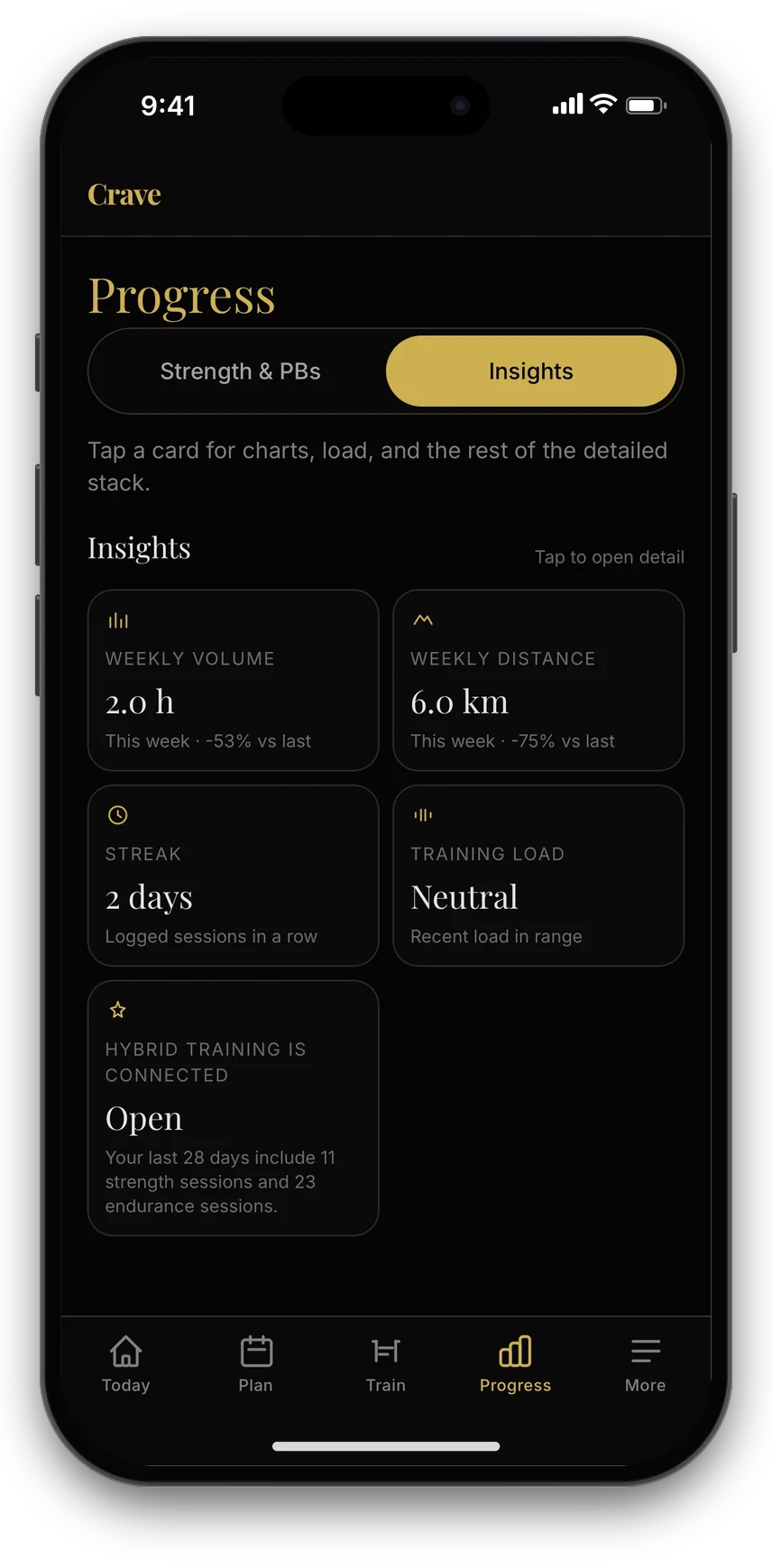
Plan the repeating week (strength, run, Hyrox-style, rest). Log the lifts. Apple Watch runs land via Apple Health — there is no standalone Watch app, and Crave does not sync Garmin. Today shows the combined load and the train / easy / push call. You can match a Watch workout to a lift you logged so duration and heart rate sit on the same row.
You still choose the sessions. Crave does not write a Hyrox or hybrid programme. Recording the Watch side of a Hyrox week? See how to track Hyrox training on Apple Watch.
Further reading
- How Crave works — TSS, CTL, ATL, TSB and the daily verdict
- How to plan a hybrid lifting and running week
- Missed a session? How to fix your lifting and running week
- Strength training for runners and Hyrox
- Hyrox training plan with lifting
- Sled push and pull for Hyrox
- Wall balls for Hyrox
- Burpee broad jumps for Hyrox
- Farmers carry for Hyrox
- Sandbag lunges for Hyrox
- DEKA training week: FIT, MILE and STRONG
- Deadly Dozen training week
- ATHX training week: strength, engine and MetCon X
- Hyrox training 3 or 4 days a week when you also lift
- Run or lift first? Double days in a hybrid week
- How to track Hyrox training on Apple Watch
- All guides
- When a coaching calendar is a better fit
- When a gym-only logger is enough
- The social endurance feed, and the week that also includes the gym
Questions
Does strength training count toward training load?
Yes. A logged gym session is scored even if it is not matched to an Apple Watch workout. Crave estimates the lift from duration, and from set count and volume when those are on the log. If you logged a session RPE, that is used instead. Heart rate is used when the Watch (or another Health workout) supplies it and there is no RPE.
What is a good TSB before a Hyrox race?
Crave does not publish a race-week TSB target. It only labels form from the load numbers: below −10 is fatigued, −10 through +5 is neutral, above +5 is fresh. Fresh is the band where Today can say ready to push, if sleep is also fine. That is a label about load, not a race plan.
Do I need a Garmin?
No. Crave reads Apple Watch workouts from Apple Health. It does not sync Garmin or Strava.
Is Crave’s readiness medical advice?
No. Training load, the daily verdict and the readiness score are estimates from your workouts, sleep and HRV when those readings exist. They are not a diagnosis and not medical advice.