Guide · updated 3 November 2026
Wall balls for Hyrox: fitting them into your lifting and running week
One focused wall ball session a week, plus short sets on tired legs if you want that feel. Keep the focused day off the eve of your heaviest squat day and your hardest run. Practise lunges then wall balls sometimes — that is race order. This is a placement choice, not a second squat-and-press day.
Jamie Firth, Hyrox and triathlon. This is planning advice, not a coaching programme, a tested protocol or medical advice. Hyrox is used here as the name of the race format, not as a partnership.
Why wall balls clash with lifting
A wall ball is a squat into a press. The legs drive; the shoulders finish. That is the same pair of demands as a heavy squat day and a press day. Put a long wall ball session on the eve of your heaviest squat, and the squat becomes a grind. Put it the day before a quality run or a long run, and the run becomes a shuffle. Put it after a hard press day, and the lockout is already cooked.
That overlap is why a hybrid week treats wall balls as a hard day — next to the heavy lift and the hardest run — not as a light accessory you can drop in anywhere. Most of the week’s running should still be easy. The wall ball day does not replace the aerobic day. For the week that already has a functional slot, see the Hyrox training plan with lifting. If that slot is sled work instead, see where sled push and pull sit in a lifting week. If it is burpee broad jumps, see where burpee broad jumps sit next to heavy pressing. If it is farmers carry, see where farmers carry sits next to deadlift day. If it is sandbag lunges — the station that leads into wall balls — see where sandbag lunges sit next to a squat day. Only have 3 or 4 days? See Hyrox training on 3 or 4 days a week when you also lift.
Three ways to place it
Pick one pattern and repeat it. Examples, not prescriptions. They match the shape of the Hyrox training plan with lifting. Racing your first Hyrox? See the 8-week build for lifters.
1. A wall ball skill day
The cleanest split: one gym lift, one wall ball or station session, easy running in between. Wednesday is the skill day, off Monday legs and Sunday’s long run, and not the eve of the heaviest squat.
| Day | Session | Why |
|---|---|---|
| Monday | Strength (squat, press, pull) | The heavy gym day, while you are fresh |
| Tuesday | Easy run | The clean aerobic day this week |
| Wednesday | Wall ball skill session | The focused wall ball day, off Monday legs |
| Thursday | Rest | Space after the hard day |
| Friday | Easy run, ride or swim | Keep the engine ticking without another hard lower-body piece |
| Saturday | Quality run or a second lift | The run quality day, or rest if Wednesday was enough |
| Sunday | Longer run | The endurance session, on fresher legs |
2. A short finisher after lower-body lifting
If you want the feel of wall balls on tired legs, add a short finisher after the lower-body lift — not a second long session. Keep the focused skill work off this day if the finisher is already enough.
| Day | Session | Why |
|---|---|---|
| Monday | Lower body, then a short wall ball finisher | Tired-leg practice, kept short so it is not a second squat session |
| Tuesday | Easy run | The clean aerobic day |
| Wednesday | Rest | Space after the stacked lower-body day |
| Thursday | Upper body (press, pull) | The press day, off Monday’s shoulders |
| Friday | Easy run, ride or swim | Keep the engine ticking |
| Saturday | Quality run or rest | The run quality day, a day away from Monday |
| Sunday | Longer run | The endurance session |
Keep the finisher short. A long grind after a full squat session is still two hard pieces on the same day. If you do two sessions on one day, see whether to run or lift first.
3. Wall balls inside a compromised-running brick
Closer to a race, the skill is running after the station, not the station on its own. Put wall balls into a short run on one day, and leave the other runs clean. That is compromised running — see where compromised running sits in a lifting week.
| Day | Session | Why |
|---|---|---|
| Monday | Strength (squat, press, pull) | The heavy gym day, while you are fresh |
| Tuesday | Easy run | The clean aerobic day this week |
| Wednesday | Compromised run: wall balls + short run | The hard mixed day, off Monday legs and Sunday’s long run |
| Thursday | Rest | Space after the hard day |
| Friday | Easy run, ride or swim | Keep the engine ticking without another compromised piece |
| Saturday | Lunges then wall balls, or rest | Race-order practice without a run, or rest if Wednesday was enough |
| Sunday | Longer run | The endurance session, on fresher legs |
Title Wednesday whatever you actually do — “Compromised run: wall balls + 1 km”. Do not make every run a wall-ball-into-run. If every run is compromised, you lose the aerobic day. Practise lunges then wall balls on some weeks, not every week — that pairing is race order, not a permanent extra session.
Pacing a set of 100
If you are practising a long set — a hundred wall balls is the usual example — decide the breaks before you start. A long set falls apart when you invent the rest in the middle. Pick a simple pattern you can still hold when the legs are already tired, and repeat that pattern. This is a pacing principle, not a prescribed split, and not a claim about race volume.
Do not turn the skill day into a new scheme every week. The value is holding the same plan when you are tired, not finding a cleverer break-up.
Race week and deload
Drop wall ball volume in both. Race week is for staying sharp, not for a long unbroken set or a new ball. Keep any station work short and familiar, early in the week — see Hyrox race week when you also lift. A routine deload week keeps the same days and cuts the work; the Hyrox-shaped version there cuts station work and compromised running. Do not replace either week with a full simulation.
How to plan it in Crave
Crave does not write a wall ball or Hyrox programme. You place one wall ball or station session on a repeating week (strength, hybrid, structured, cardio, rest). Today shows plan versus actual. You can move or add that session for this week only; the usual week comes back the next Monday unless you override that week too. If a lift or run does not happen, see what to do when you miss a session.
Wall Ball is in the exercise library, in the Functional group, seeded with the rest of the catalog. The alias Wall Ball Shot resolves to the same exercise. You do not need a custom exercise for those names. Log it as strength sets: kilograms and reps. The set form fills last weights when you have them. Leave kilograms empty if you are not tracking the ball weight — an empty weight is stored as unloaded. Crave does not log wall balls as reps only. Walking Lunge, Sandbag Walking Lunge and Kettlebell Walking Lunge are in the library if you log the race-order pairing.
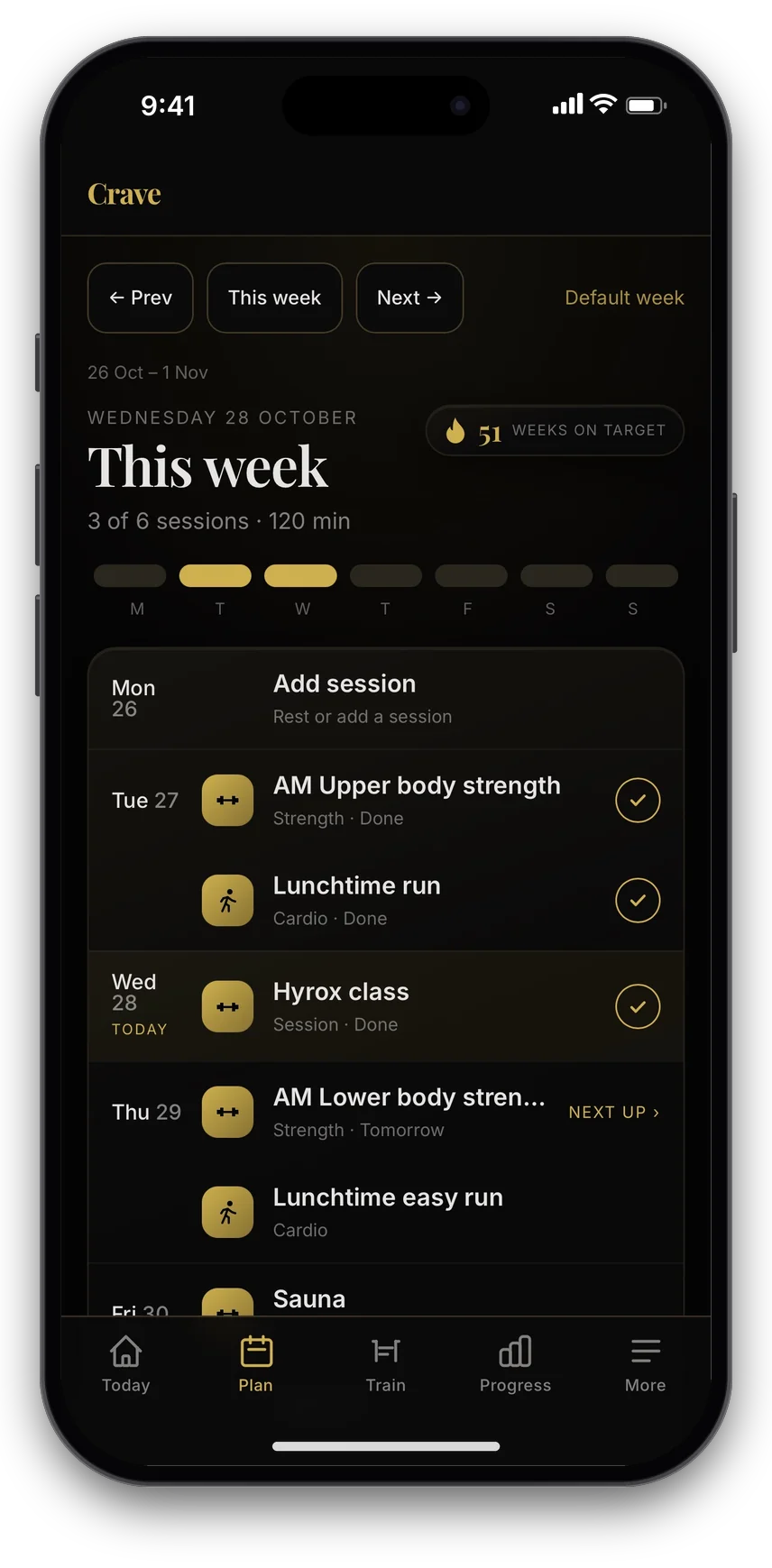
Record the session on Apple Watch as Functional Strength Training. For a wall-ball-into-run brick, start Outdoor Run or Indoor Run, swipe right, tap New, and pick Functional Strength Training; or record a short mixed piece as HIIT. Each workout the watch writes to Apple Health appears in Crave as its own row. Two Health workouts can each tick a planned session; one combined workout is one row. Crave does not split a combined session into segments, and it does not promise that swipe-right New always arrives as two workouts. A Watch workout named only Functional Strength Training is a strength-type Health row; a log named Wall Ball or Wall Ball Shot is Hyrox-style work in Today’s progress. For the mapping, see how to track Hyrox training on Apple Watch.
Training load includes the sessions you log and the Watch workouts Health sends. Work titled with wall ball, Hyrox or functional is grouped as functional load, next to the run — see training load for lifting and running. There is no standalone Watch app, and Crave does not sync Garmin or Strava. A daily train / easy / rest verdict uses that load history, plus HRV and sleep when Health has them. Those are estimates, not medical advice.
Related guides
- Hyrox training plan with lifting
- First Hyrox in 8 weeks: a beginner plan for lifters
- Sled push and pull for Hyrox
- Burpee broad jumps for Hyrox
- Farmers carry for Hyrox
- Sandbag lunges for Hyrox
- DEKA training week: FIT, MILE and STRONG
- Deadly Dozen training week
- ATHX training week: strength, engine and MetCon X
- Hyrox training 3 or 4 days a week when you also lift
- Compromised running for Hyrox
- Hyrox race week: how to taper when you also lift
- Deload week for running and lifting
- Training load for lifting and running
- Missed a session? How to fix your lifting and running week
- How to track Hyrox training on Apple Watch
- All guides
Questions
How often should I train wall balls for Hyrox?
One focused wall ball session a week is enough for most hybrid weeks, plus short sets on tired legs if you want that feel. Keep the focused day off the eve of your heaviest squat day and your hardest run. Practise lunges then wall balls sometimes — that is race order.
Can I do wall balls on squat day?
You can, as a short finisher after the lift, if you want tired-leg practice. They overlap: wall balls load the quads and the shoulders, the same family as squats and presses. A long wall ball session on the heaviest squat day is two hard lower-body pieces stacked. Keep the focused skill day off that eve.
How do I break up 100 wall balls?
Decide the breaks before you start. A long set falls apart when you invent the rest in the middle. Pick a simple pattern you can hold when the legs are already tired, and practise that pattern — not a new split every session. This is a pacing principle, not a prescribed set scheme.
Does Crave track wall balls?
Yes, as a library exercise, not a custom exercise: Wall Ball sits in the Functional group, with the alias Wall Ball Shot. Log it as kilograms and reps. A Watch Functional Strength Training workout from Apple Health appears as its own row and can tick a planned session when the types line up. A log named Wall Ball is Hyrox-style work in Today’s progress, and training load groups it as functional. Crave does not log wall balls as reps only, and it does not split a combined Watch workout into stations.