Guide · updated 25 November 2026
Deadly Dozen training week: plan it around lifting and running
Keep your lifting and running week. Make one gym day carry-and-grip focused, turn one run into 400 m repeats, and add one run-plus-Labour circuit. Build loads toward the official race weights. Crave does not write the programme — you set the repeating week yourself.
Jamie Firth. Deadly Dozen facts checked on 12 November 2026 against the official Deadly Dozen homepage, race formats and weights, free six-week training plan and hybrid training plan journal. Deadly Sprint facts checked on 25 November 2026 against the official Deadly Sprint page and the Germany Sprint page for per-Labour reps and distances. Where a rule could not be verified on those sources, it is left out. Deadly Dozen is a trademark of its owner, used here as the name of the event format, not as a partnership. This is planning advice, not a coaching programme, a tested protocol or medical advice.
How the original Track Race works
On the official site, the original Track Race alternates twelve 400-metre runs — the Journeys, 4.8 km total — with twelve functional stations — the Labours — in the same order at every race. You race Solo (all twelve Journeys and all twelve Labours yourself), in Pairs (run every Journey together and share the work in each Labour), or as a Relay (one Journey and one Labour before tagging the next teammate; each athlete completes three rounds). Those division lines are on the format guide.
Deadly Dozen also lists Gym Races at affiliate gyms and other Track formats. This page is about the original Track Race only. Open the format guide for anything else.
There is an official free six-week plan, email-gated, with three strands: strength twice a week, Journey fitness (steady runs, then tempo and intervals), and Labour fitness (race-style circuits). Link it, do not copy it: free Deadly Dozen training plan. It is a prescribed programme. This page is the other angle: you already lift and run, so which of your sessions already cover the Labours, and what one or two sessions do you add?
The 12 Labours, grouped by what your week already trains
Names, work and Men / Women race weights below are the original Track Race table on the format guide, checked on 12 November 2026. That page also totals 4.8 km of running, 900 m of carries, lunges, jumps and crawls, and 320 reps. Prefer that table to any copied one.
| Labour | Work | Men | Women |
|---|---|---|---|
| 1 · Kettlebell farmers carry | 240 m | 2 × 24 kg | 2 × 16 kg |
| 2 · Kettlebell deadlift | 60 reps | 1 × 32 kg | 1 × 24 kg |
| 3 · Dumbbell lunge | 60 m | 2 × 12.5 kg | 2 × 7.5 kg |
| 4 · Dumbbell snatch | 60 reps | 1 × 15 kg | 1 × 9 kg |
| 5 · Bodyweight burpee broad jump | 60 m | Bodyweight | Bodyweight |
| 6 · Kettlebell goblet squat | 60 reps | 1 × 16 kg | 1 × 12 kg |
| 7 · Weight-plate front carry | 240 m | 1 × 25 kg | 1 × 20 kg |
| 8 · Dumbbell push press | 60 reps | 2 × 12.5 kg | 2 × 6 kg |
| 9 · Bodyweight bear crawl | 120 m | Bodyweight | Bodyweight |
| 10 · Weight-plate clean and press | 60 reps | 1 × 15 kg | 1 × 10 kg |
| 11 · Weight-plate overhead carry | 180 m | 1 × 15 kg | 1 × 10 kg |
| 12 · Dumbbell devil press | 20 reps | 2 × 10 kg | 2 × 5 kg |
- Hinge and squat: kettlebell deadlift, goblet squat, dumbbell snatch. These already sit in a lifting week.
- Presses: dumbbell push press, plate clean and press, dumbbell devil press. Keep a long Labour circuit off the heaviest press day.
- Carries and grip: farmers 240 m, front carry 240 m, overhead carry 180 m. Three carry Labours. See where farmers carry sits in a lifting week — that page is a Hyrox guide (Hyrox is a 200 m kettlebell carry), reused here because the grip pattern overlaps, not Deadly Dozen-official.
- Legs and bodyweight: dumbbell lunge 60 m, burpee broad jump 60 m, bear crawl 120 m. See where burpee broad jumps sit next to heavy pressing and where sandbag lunges sit next to a squat day — both are Hyrox pages (Hyrox lunges are a 100 m sandbag station), not Deadly Dozen-official. The Track Race lunge is a dumbbell 60 m Labour.
Training for Deadly Sprint instead?
Deadly Sprint is the Deadly Dozen cut in half: 12 × 200 m runs (2.4 km in total, vs 4.8 km), the same 12 Labours at half the reps, and the same weights. It is held on an indoor athletics track (the Dozen is outdoor). Divisions are Solo and Pairs — the Dozen also has Relay. Pairs run the 200 m together and split each Labour however they like. Those lines are on the official Deadly Sprint page, checked on 25 November 2026. The name is the distance, not the pace: the official page says “Jog it, run it or sprint it”. Check the official calendar for dates — they change.
| Deadly Sprint | Deadly Dozen | |
|---|---|---|
| Runs | 12 × 200 m | 12 × 400 m |
| Total running | 2.4 km | 4.8 km |
| Labours | Half reps, same weights | Full reps |
| Venue | Indoor athletics track | Outdoor athletics track |
| Divisions | Solo and Pairs | Solo, Pairs and Relay |
What changes in the week: keep both strength days and the carry and grip work, because the weights are the same. Shorten the 400 m repeats to 200 m repeats. Make the run-plus-Labour circuit 200 m runs with half-volume Labour sets.
Deadly Sprint exercises: the 12 Labours at half reps
Deadly Sprint uses the same 12 Labours and the same weights as the Deadly Dozen, with each Labour's reps or distance halved and a 200 m run before each one: farmers carry 120 m, deadlift 30, lunge 30 m, snatch 30, burpee broad jump 30 m, goblet squat 30, front carry 120 m, push press 30, bear crawl 60 m, clean and press 30, overhead carry 90 m, devil press 10.
| # | Labour | Sprint | Dozen | Men | Women |
|---|---|---|---|---|---|
| 1 | Kettlebell farmers carry | 120 m | 240 m | 2 × 24 kg | 2 × 16 kg |
| 2 | Kettlebell deadlift | 30 reps | 60 reps | 1 × 32 kg | 1 × 24 kg |
| 3 | Dumbbell lunge | 30 m | 60 m | 2 × 12.5 kg | 2 × 7.5 kg |
| 4 | Dumbbell snatch | 30 reps | 60 reps | 1 × 15 kg | 1 × 9 kg |
| 5 | Burpee broad jump | 30 m | 60 m | Bodyweight | Bodyweight |
| 6 | Kettlebell goblet squat | 30 reps | 60 reps | 1 × 16 kg | 1 × 12 kg |
| 7 | Weight-plate front carry | 120 m | 240 m | 1 × 25 kg | 1 × 20 kg |
| 8 | Dumbbell push press | 30 reps | 60 reps | 2 × 12.5 kg | 2 × 6 kg |
| 9 | Bear crawl | 60 m | 120 m | Bodyweight | Bodyweight |
| 10 | Weight-plate clean and press | 30 reps | 60 reps | 1 × 15 kg | 1 × 10 kg |
| 11 | Weight-plate overhead carry | 90 m | 180 m | 1 × 15 kg | 1 × 10 kg |
| 12 | Dumbbell devil press | 10 reps | 20 reps | 2 × 10 kg | 2 × 5 kg |
Sprint reps and distances: official Deadly Dozen Germany Sprint page (deadlydozen.de/sprint); same weights: deadlydozen.com. Checked 25 November 2026. Check your event's athlete brief, as standards can change.
What this means for training. Carries and grip work count as much as in the Dozen because the weights do not change. The Sprint totals are 240 m of farmers and front carries plus a 90 m overhead carry, 120 m of lunges, jumps and crawls, and 160 reps. That is half the Dozen's moving and rep volume, with the same loads.
A 3-day Sprint week
Planning guidance, not an official programme. Session types only. Strength, hybrid, cardio, rest — the same labels Crave uses on the week. Crave does not write the programme.
| Day | Session type | Why |
|---|---|---|
| Monday | Strength | The lift, with carries and grip, while you are fresh |
| Tuesday | Rest | Space after the hard lower-body and grip day |
| Wednesday | Hybrid | 200 m repeats into a short Labour circuit |
| Thursday | Rest | Space after the mixed day |
| Friday | Rest | Keep Saturday empty so Sunday is not a shuffle |
| Saturday or Sunday | Cardio | An easy run |
If the Sprint goes well, the step up to the Dozen is the 400 m runs and full reps; the loads don't change.
Example repeating weeks
Session types only. Examples, not prescriptions. No paces, loads or invented finish times beyond the official race weights above. Strength, hybrid, cardio, rest — the same labels Crave uses on the week.
A 4-day Solo week
| Day | Session type | Why |
|---|---|---|
| Monday | Strength | The lift, with carries and grip, while you are fresh |
| Tuesday | Rest | Space after the hard lower-body and grip day |
| Wednesday | Cardio | 400 m repeats — Journey practice, off Monday |
| Thursday | Rest | Space after the speed session |
| Friday | Hybrid | The run-plus-Labour circuit, off Monday and Sunday |
| Saturday | Rest | The day before the easy run |
| Sunday | Cardio | An easy run, not another 400 m day |
Title Friday whatever you actually do — “400s + farmers and lunges”, “Labour circuit”. The type on the plan is still hybrid. Swap Monday’s carry work onto Friday if you would rather keep Monday as a clean squat or press day.
A 3-day busy week
| Day | Session type | Why |
|---|---|---|
| Monday | Strength | The lift, including carries if you only have one gym slot |
| Tuesday | Rest | Space after Monday |
| Wednesday | Hybrid | 400 m repeats into a short Labour circuit |
| Thursday | Rest | Space after the mixed day |
| Friday | Rest | Keep Saturday empty so Sunday is not a shuffle |
| Saturday | Rest | The day before the easy run |
| Sunday | Cardio | The easy run |
Racing Pairs or Relay? Running fitness cannot be shared in Pairs — you both run every Journey — but the Labour work can. See how to train for Deadly Dozen Pairs and Relay. That page is planning advice, not an official pairs programme.
Racing Deadly Dozen alongside Hyrox or DEKA? Keep one week, not two programmes. Running between stations, burpee broad jumps, carries and lunges overlap. The original Track Race has no sled and no erg stations — do not add a sled day “for Deadly Dozen”. Start from the Hyrox training plan with lifting or DEKA training week and swap the station day for a run-plus-Labour circuit when that event is closer. Racing ATHX too? See how to fit ATHX Strength, Endurance and MetCon X around lifting — keep one week; ATHX’s max-lift test does not transfer from the Labours. Choosing between ATHX and Hyrox? See ATHX vs Hyrox.
Double days, load and taper
If a lift and a run land on the same calendar day, see whether to run or lift first. A Journey followed immediately by a Labour is one hybrid session, not a double day. Run-after-Labour practice is the same idea as compromised running for Hyrox — that page is a Hyrox analogue, not Deadly Dozen-official. If a lift or run does not happen, see what to do when you miss a session.
Load across lifts and runs is one number in Crave — see training load for lifting and running. Work titled with functional, Hyrox, farmer or sandbag is grouped as functional load, next to the run.
The week before the event, keep the same days and cut the work — see how to plan a deload when you run and lift. There is not a Deadly Dozen-specific taper page on this site. The closest analogue is Hyrox race week when you also lift: light lifting, less volume, some sharpness, not a rewrite of the usual plan. That page is a Hyrox analogue, not Deadly Dozen-official.
Recording on Apple Watch
Apple Watch has no Deadly Dozen workout type. We have not verified a “best” type for this race. A consistent approach, matching how to track Hyrox training on Apple Watch, is: Outdoor Run or Indoor Run for Journey repeats; Functional Strength Training for a Labour circuit; Traditional Strength Training for a gym lift; chain a run and a strength type with swipe-right New when both halves matter. That is a mapping you choose and keep, not an official Deadly Dozen setting and not a claim that one type is correct.
On a 400 m track, Outdoor Run is the obvious pick. Indoors, use Indoor Run so the watch is not relying on GPS. Crave does not split a combined Watch session into Labours.
Planning it in Crave
Crave is a free iPhone app. You set your own repeating week — lifts, runs, Hyrox-style or other sessions, and rest. New accounts stay empty until you tap Build my week or add a session. There is no built-in Deadly Dozen template and no Deadly Dozen session label. Workout templates are never created for you; you can save a reusable strength template after a log. Crave does not write the programme.
Log Labour circuits and carries as gym sets. Farmer Carry, Overhead Carry, Walking Lunge, Dumbbell Walking Lunge, Goblet Squat, Push Press, Devil Press, Burpee Broad Jump and Bear Crawl are in the exercise library. You do not need a custom exercise for those names. A plate front carry is not a catalog name — Front Rack Carry is the closest library row, or log a custom name. Farmer Carry and the lunge names are logged as kilograms and reps. Burpee Broad Jump and Bear Crawl are bodyweight library rows, logged as reps. Crave does not log carries or lunges as a race distance.
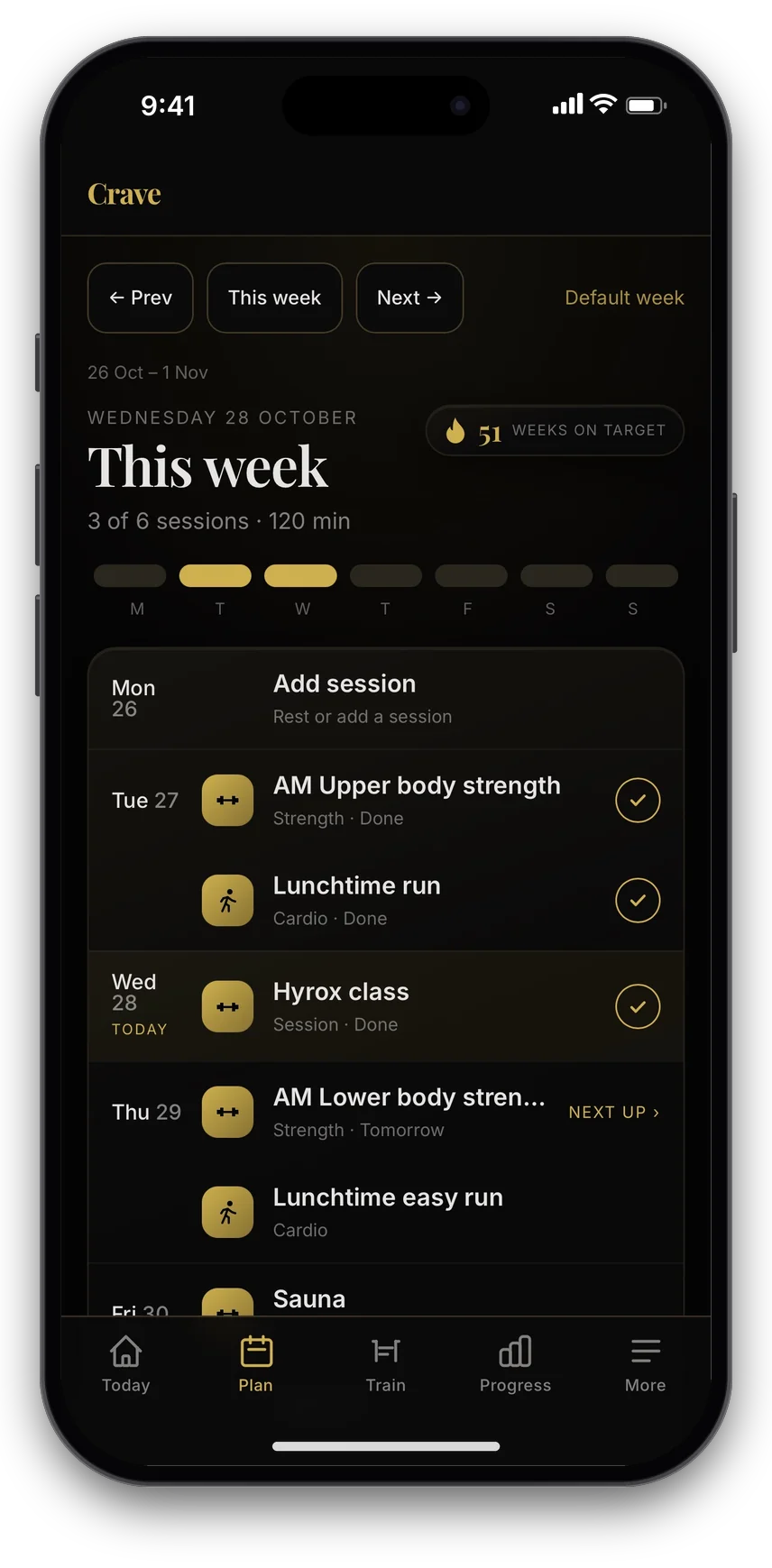
Apple Watch workouts arrive from Apple Health and can tick a planned session when the types line up. Today shows planned versus actual. Progress can show lift PBs and run bests (1 km, 5 km), and how many strength sessions and endurance sessions you recorded in the last 28 days — a count of what landed, not a target Crave sets. Training load includes the sessions you log and the Watch workouts Health sends. When sleep and HRV exist, Today can show Take it easy, Train as planned, or Ready to push. Sleep and HRV never produce a rest verdict; Take it easy still leaves the session on the plan. Those are estimates, not medical advice.
If you add a race, Plan shows a countdown and a load-guided build. That build is coaching guidance. It never writes weekly-plan rows or templates. Adding a race does not create the sessions. There is no Deadly Dozen event type — use Other, or whatever label you already use.
Limits that stay true: iPhone only; no standalone Watch app; Crave does not sync Garmin or Strava; no AI coach; no nutrition features; no programme written for you; no Deadly Dozen templates.
Related guides
- Deadly Dozen Pairs and Relay training week
- Hyrox training plan with lifting
- DEKA training week: FIT, MILE and STRONG
- ATHX training week: strength, engine and MetCon X
- ATHX vs Hyrox: differences and how to train for both
- Farmers carry for Hyrox (Hyrox 200 m station; similar grip, not Deadly Dozen-official)
- Sandbag lunges for Hyrox (Hyrox 100 m station; similar legs, not Deadly Dozen-official)
- Burpee broad jumps for Hyrox (Hyrox 80 m station; similar movement, not Deadly Dozen-official)
- How to plan a hybrid lifting and running week
- Strength training for runners and Hyrox
- Run or lift first? Double days in a hybrid week
- Missed a session? How to fix your lifting and running week
- Compromised running for Hyrox (analogue, not Deadly Dozen-official)
- Training load for lifting and running
- Deload week for running and lifting
- Hyrox race week: how to taper when you also lift (analogue, not Deadly Dozen-official)
- How to track Hyrox training on Apple Watch
- All guides
Further reading
- Deadly Dozen. Deadly Sprint — 12 × 200 m runs, half the Labour reps, the same weights; indoor track; Solo and Pairs.
- Deadly Dozen. The original Track Race — twelve 400 m Journeys and twelve Labours; Solo, Pairs and Relay.
- Deadly Dozen. Race formats and weights — the twelve Labours in order, Men / Women race weights, and other Track and Gym formats.
- Deadly Dozen. Free six-week training plan — strength twice a week, Journey fitness, Labour fitness. Email-gated; this page does not reproduce it.
- Deadly Dozen. How to build a hybrid training plan — official journal on balancing strength, endurance and recovery.
Questions
What are the 12 Deadly Dozen Labours?
The official format guide lists them in this order, each after a 400 m Journey: kettlebell farmers carry 240 m (2 × 24 / 2 × 16 kg); kettlebell deadlift 60 reps (1 × 32 / 1 × 24 kg); dumbbell lunge 60 m (2 × 12.5 / 2 × 7.5 kg); dumbbell snatch 60 reps (1 × 15 / 1 × 9 kg); bodyweight burpee broad jump 60 m; kettlebell goblet squat 60 reps (1 × 16 / 1 × 12 kg); weight-plate front carry 240 m (1 × 25 / 1 × 20 kg); dumbbell push press 60 reps (2 × 12.5 / 2 × 6 kg); bodyweight bear crawl 120 m; weight-plate clean and press 60 reps (1 × 15 / 1 × 10 kg); weight-plate overhead carry 180 m (1 × 15 / 1 × 10 kg); dumbbell devil press 20 reps (2 × 10 / 2 × 5 kg). Men / Women.
How far do you run in Deadly Dozen?
The original Track Race is twelve 400 m Journeys, 4.8 km of running in total, alternating with the twelve Labours. That line is on deadlydozen.com and the format guide.
How many days a week should I train for Deadly Dozen?
There is no official day-count. If you already lift and run, keep that week: make one gym day carry-and-grip focused, turn one run into 400 m repeats, and add one run-plus-Labour circuit. Four days is a workable Solo shape; three days is a busy-week version. Crave does not write the programme.
Can I train for Deadly Dozen and Hyrox at the same time?
Yes, as one week rather than two stacked programmes. Running between stations, burpee broad jumps, carries and lunges overlap. The original Track Race has no sled or erg stations. Keep one Labour or station day, one serious lift, and one quality run. See the Hyrox training plan with lifting. Crave does not write a combined race calendar.
What is Deadly Sprint?
Deadly Sprint is the Deadly Dozen cut in half: 12 × 200 m runs (2.4 km vs 4.8 km), the same 12 Labours at half the reps, and the same weights. It is raced on an indoor athletics track. Divisions are Solo and Pairs. The name is the distance, not the pace. That wording is on the official Deadly Sprint page.
What are the Deadly Sprint exercises?
Deadly Sprint uses the same 12 Labours and the same weights as the Deadly Dozen, with each Labour's reps or distance halved and a 200 m run before each one: farmers carry 120 m, deadlift 30, lunge 30 m, snatch 30, burpee broad jump 30 m, goblet squat 30, front carry 120 m, push press 30, bear crawl 60 m, clean and press 30, overhead carry 90 m, devil press 10.
Can I train for Deadly Sprint with the same plan?
Yes. Keep the strength days and the carry and grip work — the weights are the same. Shorten the 400 m repeats to 200 m repeats, and use half-volume Labour sets in the run-plus-Labour circuit. See Training for Deadly Sprint instead? Crave does not write the programme.