Guide · updated 22 November 2026
Deadly Dozen Pairs and Relay: train the runs, split the Labours
Pairs: you both run all 4.8 km, so running fitness cannot be shared — but the Labour work can, so train the runs individually and rehearse the splits together. Relay: 3 × (400 m + one Labour) each — train short, hard repeats and pick Labours to strengths. Crave does not write the programme — each person sets their own repeating week.
Jamie Firth. Pairs and Relay facts checked on 22 November 2026 against the official Deadly Dozen rulebook (PDF, edition date 12.11.26), the rulebook page, race formats and weights, FAQ and Deadly Sprint page. Labour names, distances and race weights stay on the format guide and in our Deadly Dozen training week — this page does not copy the weights table. Where a rule could not be verified, it is left out. Deadly Dozen is a trademark of its owner, used here as the name of the event format, not as a partnership. This is planning advice, not a coaching programme, a tested protocol or medical advice.
How Pairs and Relay work
The original Track Race is twelve 400 m Journeys and twelve Labours on an athletics track. Six Labours move along a 30 m lane (Distance Labours); six are stationary (Rep Labours). Kit is bodyweight, kettlebells, dumbbells and weight plates. Those lines are in the rulebook and on the format guide. For the Labour list and race weights, use those pages and the Solo training week rather than this one.
Divisions on the original Track Race are Solo Male / Female; Pairs Male / Female / Mixed; Relay Male / Female / Mixed — eight in total. Minimum age in the rulebook is 16 on race day. Pairs age category is the two athletes' ages on 31 December of the race year, averaged and rounded down. Relay awards are Overall and Masters (team average age 50 or over).
- Pairs (two athletes). Both run every 400 m Journey together. Both are involved in each Labour, but you can split it any way: one does the whole Labour, or you alternate. Equipment must be put on the floor before the partner takes over — no passing. On Distance Labours the pair must move together (one walking or jogging). One timing chip.
- Relay (four athletes). Each athlete does 1 Journey + 1 Labour, then the next goes. Each person completes 3 Journeys + 3 Labours. You cannot do two Journeys and Labours back-to-back. Athletes choose which Labours, but race order is fixed. Mixed relay is 2 male + 2 female; each uses their own sex's weights. All four wear chips, unless one chip is issued and used as a baton.
Those are rulebook facts. Wave times on the day are listed as a guide on the official site and can change, so this page does not print them. Open the current rulebook before you enter.
The mixed-pairs weight rule
Mixed pairs use the male weights. Female-only pairs use the female weights. That is a rulebook line, not coaching. Race loads themselves are on the official format guide — this page does not copy the numbers.
Planning advice, ours, not a Deadly Dozen claim: the lighter partner should train toward male loads on the Labours they will actually take, or the stronger partner takes the heavier Labours. Do not assume mixed pairs get the female table. Relay is different: each athlete uses the weights for their own sex.
Splitting the Labours
Who takes which is a team decision, not an official split. Group the twelve by what your week already trains — the grouping is on the Deadly Dozen training week (hinge and squat, presses, carries and grip, legs and bodyweight). Practise “put it down, partner picks it up”. On Distance Labours rehearse moving together, because one of you cannot run ahead to the next cone.
Carries overlap with where farmers carry sits in a lifting week — that page is a Hyrox guide (Hyrox is a 200 m kettlebell carry), reused here because the grip pattern overlaps, not Deadly Dozen-official. The Track Race farmers Labour is 240 m. Lunges overlap with where sandbag lunges sit next to a squat day — also a Hyrox page (Hyrox lunges are a 100 m sandbag station). The Track Race lunge is a 60 m dumbbell Labour.
Example Pairs week
Session types only. An example for two people who already lift and run, not a prescription and not an official pairs programme. No paces, loads or invented finish times. Strength, hybrid, cardio, rest — the same labels Crave uses on the week. Each partner keeps their own two lifting days and an easy run. Once a week you train together: 6–8 × 400 m at the slower partner's pace, then a split Labour circuit.
A 4-day Pairs week (each person)
| Day | Session type | Why |
|---|---|---|
| Monday | Strength | Your own lift. Keep it. The partner's Monday can be a different lift. |
| Tuesday | Rest | Space after the gym day |
| Wednesday | Hybrid | The shared session: 400 m repeats together, then a split Labour circuit |
| Thursday | Rest | Space after the mixed day |
| Friday | Strength | Your second lift. Point it at the Labours you will take. |
| Saturday | Rest | The day before the easy run |
| Sunday | Cardio | Your own easy run. Running fitness is not shared in Pairs. |
Title Wednesday whatever you actually do — “400s with Sam + farmers and lunges”, “split Labour circuit”. The type on the plan is still hybrid. You cannot log one week for two people in Crave; each of you saves this shape on your own phone.
A 3-day busy week
| Day | Session type | Why |
|---|---|---|
| Monday | Strength | Your own lift, including the Labours you will take if you only have one gym slot |
| Tuesday | Rest | Space after Monday |
| Wednesday | Hybrid | The shared 400 m repeats into a short split Labour circuit |
| Thursday | Rest | Space after the mixed day |
| Friday | Rest | Keep Saturday empty so Sunday is not a shuffle |
| Saturday | Rest | The day before the easy run |
| Sunday | Cardio | Your own easy run |
Drop the second lift, not the shared Wednesday and not the easy run. Pairs still run every Journey on race day.
Example Relay week
Relay is shorter work more often: each athlete runs three 400 m legs with a Labour after each, then sits out while three teammates go. Train 400 m repeats with long rest, plus the three Labours you have picked. That is sprint-style, with less endurance volume than a Solo week. Session types only; not an official relay programme.
| Day | Session type | Why |
|---|---|---|
| Monday | Strength | The three Labours you will race, while you are fresh |
| Tuesday | Rest | Space after the lift |
| Wednesday | Cardio | 400 m repeats with long rest — Journey practice, not a Solo-length set |
| Thursday | Rest | Space after the speed session |
| Friday | Hybrid | One Journey into one Labour, three times, with full rest between turns |
| Saturday | Rest | The day before the easy run |
| Sunday | Cardio | An easy run, shorter than a Solo endurance week |
If the four of you can train together, Friday is the day to rehearse the tag: kit down, next athlete goes, nobody doubles up. If you cannot, each person still practises Journey-then-Labour as a hybrid session on their own week. Mixed relay: train the weights for your own sex, not the mixed-pairs male table.
Planning it on iPhone with Crave
Crave is a free iPhone app. Each partner plans their own week — lifts, runs, and the shared practice as a hybrid session — and tracks load via Apple Watch / Apple Health. New accounts stay empty until you tap Build my week or add a session. There is no built-in Deadly Dozen template, no Deadly Dozen session label, and no partner, team, pairs or shared-plan feature. Workout templates are never created for you; you can save a reusable strength template after a log. Crave does not write the programme.
Log Labour circuits and carries as gym sets. Farmer Carry, Overhead Carry, Walking Lunge, Dumbbell Walking Lunge, Goblet Squat, Push Press, Devil Press, Burpee Broad Jump and Bear Crawl are in the exercise library. You do not need a custom exercise for those names. A plate front carry is not a catalog name — Front Rack Carry is the closest library row, or log a custom name. Farmer Carry and the lunge names are logged as kilograms and reps. Burpee Broad Jump and Bear Crawl are bodyweight library rows, logged as reps. Crave does not log carries or lunges as a race distance.
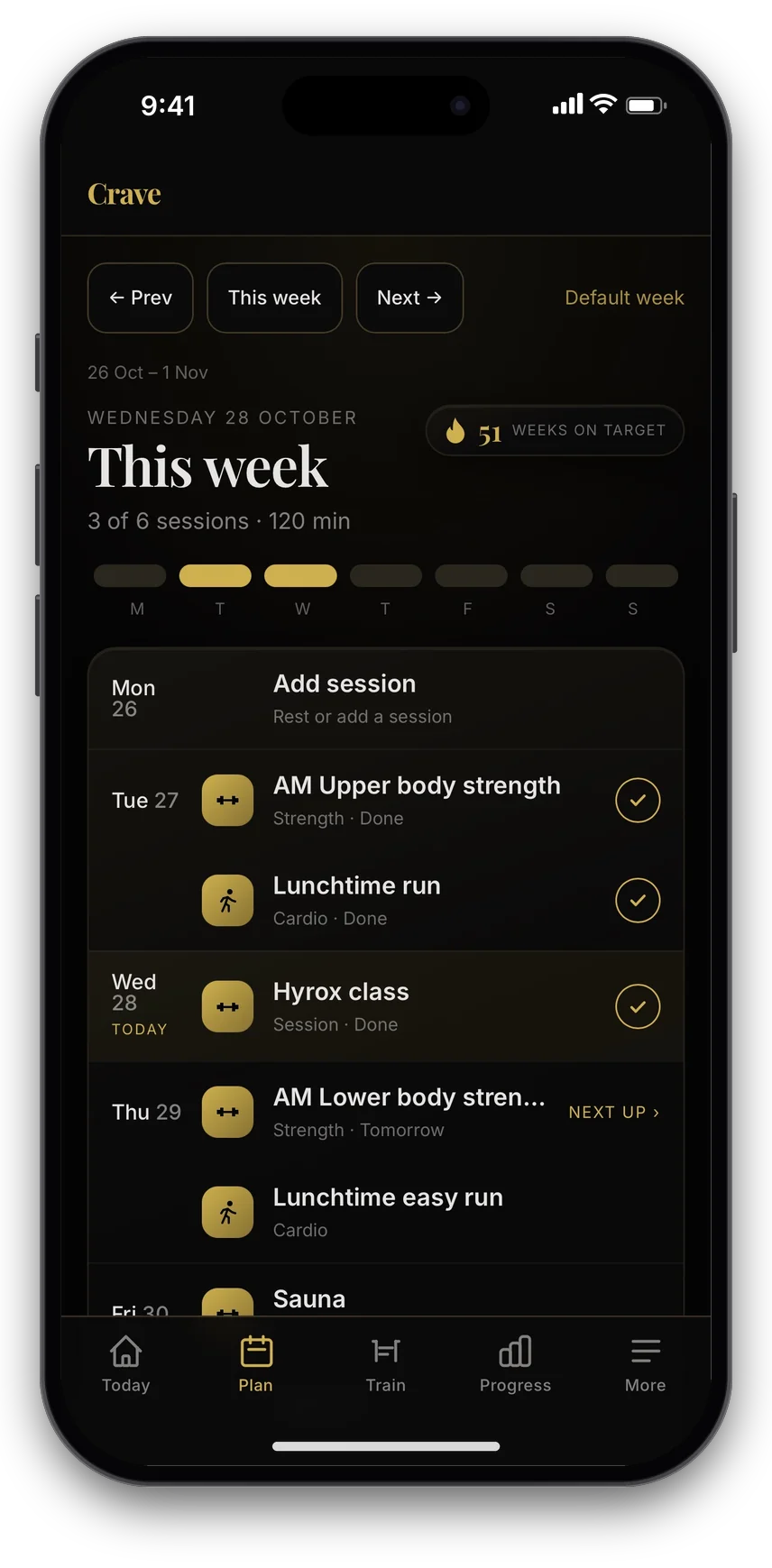
Apple Watch workouts arrive from Apple Health and can tick a planned session when the types line up. Today shows planned versus actual. Progress can show lift PBs and run bests (1 km, 5 km), and how many strength sessions and endurance sessions you recorded in the last 28 days — a count of what landed, not a target Crave sets. Training load includes the sessions you log and the Watch workouts Health sends. When sleep and HRV exist, Today can show Take it easy, Train as planned, or Ready to push. Sleep and HRV never produce a rest verdict; Take it easy still leaves the session on the plan. Those are estimates, not medical advice. Load across lifts and runs is one number — see training load for lifting and running.
If you add a race, Plan shows a countdown and a load-guided build. That build is coaching guidance. It never writes weekly-plan rows or templates. Adding a race does not create the sessions. There is no Deadly Dozen event type — use Other, or whatever label you already use. Each person adds the race on their own account. If a lift and a run land on the same calendar day, see whether to run or lift first. A Journey followed immediately by a Labour is one hybrid session, not a double day. If a session does not happen, see what to do when you miss a session.
Limits that stay true: iPhone only; no standalone Watch app; Crave does not sync Garmin or Strava; no AI coach; no nutrition features; no programme written for you; no Deadly Dozen templates; no partner or team features.
Related guides
- Deadly Dozen training week — Solo shape, the twelve Labours, and Deadly Sprint
- How to plan a hybrid lifting and running week
- Run or lift first? Double days in a hybrid week
- Farmers carry for Hyrox (Hyrox 200 m station; similar grip, not Deadly Dozen-official)
- Sandbag lunges for Hyrox (Hyrox 100 m station; similar legs, not Deadly Dozen-official)
- Training load for lifting and running
- Missed a session? How to fix your lifting and running week
- Deload week for running and lifting
- How to track Hyrox training on Apple Watch
- Hyrox training plan with lifting
- DEKA training week: FIT, MILE and STRONG
- ATHX training week: strength, engine and MetCon X
- All guides
Further reading
- Deadly Dozen. Official rulebook (PDF) — Pairs, Relay, mixed-pairs weights, chips, age. Edition date 12.11.26, re-checked 22 November 2026.
- Deadly Dozen. Rulebook page — always the current book. Share that link, not a saved file.
- Deadly Dozen. Race formats and weights — Solo, Pairs and Relay in one line, and the twelve Labours with Men / Women race weights.
- Deadly Dozen. Deadly Sprint — Solo and Pairs; 12 × 200 m; no Relay.
- Deadly Dozen. FAQ — “Can I race with someone else?”
Questions
Do pairs run every lap together?
Yes. The official rulebook says both athletes run every 400 m Journey together. Labour work can be split any way you like; the running cannot. Deadly Sprint pairs run every 200 m together in the same way — see the Deadly Sprint page.
Do mixed pairs use women's weights?
No. Mixed pairs use the male weights. Female-only pairs use the female weights. Those lines are in the official rulebook. Race weights themselves are on the format guide — this page does not copy the table.
Can relay runners pick Labours?
Yes. Each athlete chooses which Labours they complete, but the race order is fixed. Each person does one Journey and one Labour, then tags the next teammate. Nobody does two Journeys and Labours back-to-back. Each athlete completes three Journeys and three Labours in total.
Is Deadly Sprint available as pairs?
Yes. Deadly Sprint divisions are Solo and Pairs. Pairs run the 200 m together and split each Labour however they like. Sprint has no Relay division. That wording is on the official Deadly Sprint page.